Perseverance

Debby
Debby Bartz, UNHS Academic Adviser

As an adviser, I work with seniors who go through many emotions in their final months of high school. Some are very anxious to graduate and complete their courses earlier than expected, some will continue to pace themselves to the finish at the planned time, and some want to slow down as they near to end to enjoy their high school years a while longer.

No matter how they are feeling, all have choices to make as they near graduation. Whether they want to go faster or slower to the finish line, my wish for all seniors is to capitalize on perseverance and lead yourself to many joys along the way.

I’ve been blessed by perseverance as a lifetime student. My history thrives around the ongoing pursuit of knowledge for either personal, social, sustainable, or professional goals. I’ve climbed a mountain of tasks, rolled down the hills, landed in pastures and pushed through to a finish line to find the beginning of new goal. I find the glory of overcoming any obstacle with perseverance.

Perseverance may be hard to find when you’re in high school and only starting to learn about yourself as a learner and a young adult. How can you find and capitalize your own perseverance?

  • Spend time with family and friends.
  • Learn something new to keep your tank full and brain working.
  • Work with a team to care for others.
  • Be grounded to deal with the tethered threads of life choices.
  • Find courage to keep learning new skills.
  • Explore creativity.
  • Wear a smile every day!

The choices you have to make like when to graduate and what to do after graduation may be scary—change always is. All you need to do is live with hope, a big shovel of resiliency, and two buckets of perseverance. I promise you will make it through!


The End Goal of High School

Hugh
Hugh McDermott, UNHS Principal

High school principals and teachers value all of the experiences, activities and opportunities that students have along the way, but make no mistake, the end goal is to give students their diplomas.

When that day and hour arrives, the moment is indescribable! Parents, grandparents, friends and former teachers all raise their heads to acknowledge their students and how proud they are of them for attaining this rite of passage.

Students are capped and gowned. Teachers and other staff have taken their various places for the ceremony but also to do what they do best, help students even in this most anxious time to make this very special event—the best ever. There is an electricity and buzz in the air like no other.

As you work toward this most prestigious accomplishment, here are some things to think about:

  1. What am I doing to reach my graduation goal—right now?
  2. If my grades are not what I want them to be, what can I change in my study habits, right now, that will lead to better grades?
  3. If I need tutor help, who can I turn to, to make this happen?

Graduation opens an infinite number of opportunities and adventures!
And remember, the teachers and staff are there to help you reach that goal.

“The Next Play”

Ray
Ray Henning, Academic Adviser

In sports competition, what is the most important play?

You are likely to get many different answers depending on who you ask. However, to most coaches, the correct response they want from their athletes is, “the next play”.

This is a vital message coaches need to communicate to his/her team and individual players. Participants cannot be focused on what previously took place on the field, court, etc. All of their attention needs to be on what is going on in present time. If an athlete is still thinking about what just happened—either positive or negative—it takes away from their concentration on the next action.

Similarly, as you work on your academics, it is important to keep your focus on what you are currently doing. If you just had a grade you really like or one that was not so fantastic, you need to refocus and get your attention on what you are doing now. This enables you to do the best you can on the current project, assignment, test, or evaluation.

Learn from your past and prepare for your future, but focus on what you are learning today!

What is the “next play” for you?

“Luck of the Irish” To You!

Barbara
Barbara Wolf Shousha, UNHS Director

St. Patrick’s Day is an annual celebration on March 17. What began as a commemoration of the patron saint of Ireland has become a fun-filled celebration of all things Irish.

Not Irish? It does not matter!

At celebrations throughout the world, you will be informed that everyone is Irish on St. Patrick’s Day! You will see green clothing, green hair and green shamrocks. The city of Chicago even dyes the river green. You will hear St. Patrick’s Day expressions such as “Erin Go Bragh,” “Kiss the Blarney Stone” and my personal favorite “Luck of the Irish to You!”

“Luck of the Irish!” I love this expression because for years I misunderstood it. I believed it meant something like extreme good fortune. But an Irish-American friend explained that it really encompasses the sense of luck that you make yourself through your own positive outlook and determination. I liked that meaning so much better!

While I enjoy the idea of luck—wishes on a falling star, crossing my fingers—I believe in being positive and being prepared. Whether facing an exam, hoping for an opportunity or approaching a challenge in your life, it’s fun to make a wish, but you are more likely to find the luck you need when you put forth effort and have a positive attitude.

So when I wish you the “Luck of the Irish,” I really wish you the happiness and good fortune that comes from knowing that you have prepared yourself for the good things you want to come your way.

Get Back to the Fundamentals!

Ray
Ray Henning, UNHS Academic Adviser

Fundamentals are the basic skills, techniques, etc. that serve as the foundation of any system. Being fundamentally sound is an essential if you want to be successful at something.

Throughout my years of coaching football, the team that was the most successful was usually the team that did the best in the basic fundamentals of blocking and tackling. Most football coaches plan to spend a significant part of their practice time developing or enhancing these essential skills with their players. If you are not fundamentally sound at blocking and tackling in football, you are going to struggle.

How are you in the basic fundamentals of being a good student?

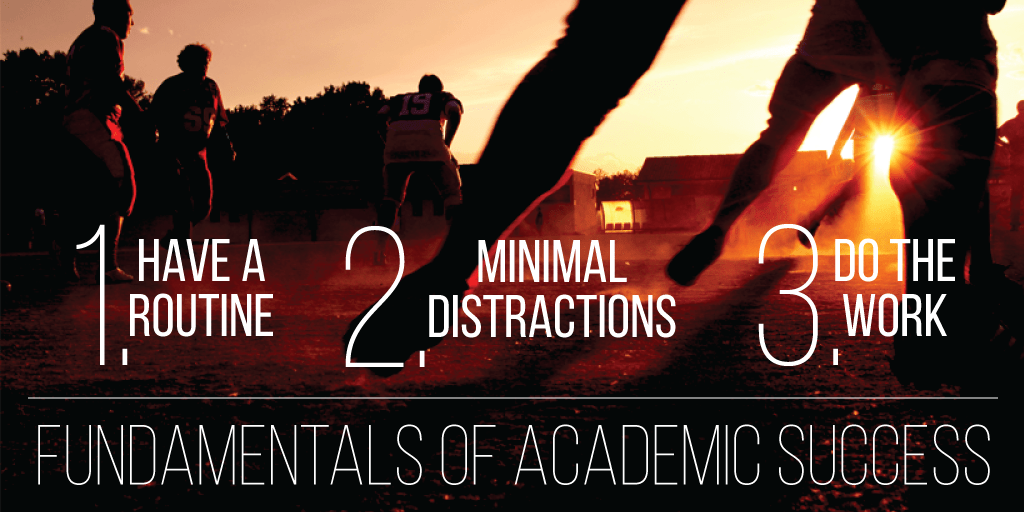
Although this is not an exhaustive list, here are three standard fundamentals that can help lead you to academic success:

  1. A regular study schedule or routine
  2. A study environment that has minimal distractions
  3. Completing all required homework and assigned readings

Just as there are many additional skills in football besides blocking and tackling (i.e. passing the ball, catching the ball, rushing the passer, causing turnovers, etc.) there are also many other important skills in your development as a student: writing, reading and test taking to name a few.

After you set the foundation with the basic fundamentals, you can start working on these additional skills.

What academic fundamentals do you need to work on to help you be the best student you can be?