“The Next Play”

Ray
Ray Henning, Academic Adviser

In sports competition, what is the most important play?

You are likely to get many different answers depending on who you ask. However, to most coaches, the correct response they want from their athletes is, “the next play”.

This is a vital message coaches need to communicate to his/her team and individual players. Participants cannot be focused on what previously took place on the field, court, etc. All of their attention needs to be on what is going on in present time. If an athlete is still thinking about what just happened—either positive or negative—it takes away from their concentration on the next action.

Similarly, as you work on your academics, it is important to keep your focus on what you are currently doing. If you just had a grade you really like or one that was not so fantastic, you need to refocus and get your attention on what you are doing now. This enables you to do the best you can on the current project, assignment, test, or evaluation.

Learn from your past and prepare for your future, but focus on what you are learning today!

What is the “next play” for you?

Comparison- A Good or Bad Thing?

Ray
Ray Henning, UNHS Academic Adviser

Something that is done a lot in our society is comparison.

People compare themselves with others in many aspects of life. Some of the common areas of comparison are appearance, athletics, education, occupations, possessions, finances, etc. We can feel good or bad about ourselves depending to who or what we are being compared.

Former U.S. President, Teddy Roosevelt, once said, “Comparison is a thief of joy.”

Personally, I have mixed feelings about comparisons. My competitive side sometimes likes to see where I rank to others, but I also realize many comparisons are not fair.

For example, having worked in education for almost 40 years, I have witnessed schools being compared by test scores and designated good or bad based solely on these scores. Obviously, the student clientele at all schools is not the same. To say a school is better because their test scores are higher than another school, may have just a lot to do with who is at the school, rather than what or how the students are being taught.

Using an athletic illustration, imagine two athletes, one with a talent level of ten and the other with a talent level of five. The first athlete is performing at a six and the second athlete is performing at a four. Although a six is higher than a four, the first athlete is using only 60% of his/her ability and the second athlete is performing at 80% of ability—so who is the better athlete?

Thus, perhaps a better way to use comparison is in the area of self-analysis. Are you getting better in whatever areas you are striving to improve?

  1. A good first step is to identify a baseline, a starting point.
  2. The next step is to work to get better and you need to check periodically if you are showing growth.

I particularly like this quote from the famous UCLA basketball coach, John Wooden:

“Success is the peace of mind, which is a direct result of self-satisfaction in knowing you did your best to become the best that you are capable of becoming.”

Things to consider: Would you describe yourself as a success? How about reducing the amount of time you spend comparing yourself to others, but taking a good look at the person in the mirror?

“Luck of the Irish” To You!

Barbara
Barbara Wolf Shousha, UNHS Director

St. Patrick’s Day is an annual celebration on March 17. What began as a commemoration of the patron saint of Ireland has become a fun-filled celebration of all things Irish.

Not Irish? It does not matter!

At celebrations throughout the world, you will be informed that everyone is Irish on St. Patrick’s Day! You will see green clothing, green hair and green shamrocks. The city of Chicago even dyes the river green. You will hear St. Patrick’s Day expressions such as “Erin Go Bragh,” “Kiss the Blarney Stone” and my personal favorite “Luck of the Irish to You!”

“Luck of the Irish!” I love this expression because for years I misunderstood it. I believed it meant something like extreme good fortune. But an Irish-American friend explained that it really encompasses the sense of luck that you make yourself through your own positive outlook and determination. I liked that meaning so much better!

While I enjoy the idea of luck—wishes on a falling star, crossing my fingers—I believe in being positive and being prepared. Whether facing an exam, hoping for an opportunity or approaching a challenge in your life, it’s fun to make a wish, but you are more likely to find the luck you need when you put forth effort and have a positive attitude.

So when I wish you the “Luck of the Irish,” I really wish you the happiness and good fortune that comes from knowing that you have prepared yourself for the good things you want to come your way.

Educators: Essential Questions

Hugh
Hugh McDermott, UNHS Principal

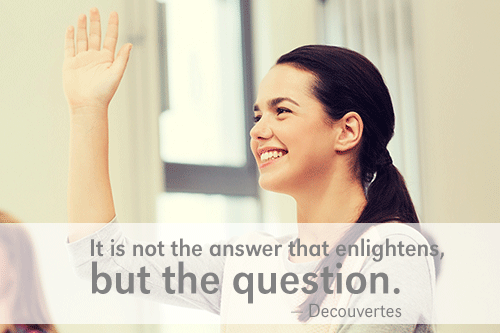
It has been estimated that teachers ask between 300 and 400 questions per day and that as many as 120 might be posed in a single hour! I remember my cooperating teacher asking me to audio-tape—remember those?—five minutes of one of my lessons. When I then listened to it, I counted 20 questions in a minute—it was awful and painful to listen to myself. I violated all types of rules such as “wait time” and a lack of variety of bloom’s taxonomy level questions. It was an important lesson.

Asking good questions is a craft that many of us have to practice. Wiggins and Wilbur (2013) wrote that essential questions rarely arise in a first draft and that writing and rewriting helps craft them. “Essential questions” stir inquiries, discussion and reflections to help students find meaning in their learning and achieve deeper thought and higher quality work. Criteria for making essential questions includes:

  • Stimulate ongoing thinking and inquiry.
  • Arguable, with multiple plausible answers.
  • Raise further questions.
  • Spark discussion and debate.
  • Demand evidence and reasoning because varying answers exist.
  • Point to big ideas and pressing issues.
  • Fruitfully recur throughout the unit or year.
  • Answers proposed are tentative and may change in light of new experiences and deepening understanding.

As we teach students in the online format, we consider the value of creating and presenting some questions within our feedback to inspire deeper thinking.

I also encourage you to keep practicing your question-making,
whether it is in the classroom, online or with your friends and family.

References
Wiggins, G., & Wilbur, D. How to Make Your Questions Essential. ASCD Educational Leadership. September 2015. 73:1.

A Cheer For Cheerful Leaders

Debby
Debby Bartz, UNHS Academic Advisor

Two bits, four bits, six bits, a dollar—all for UNHS, stand up and holler!

This was a cheer my pep club pals and I exuberantly shouted before every sporting event in high school. We were excited and loud for the upcoming competition, and the cheerleaders led us in motivating the sporting teams.

Today, I treasure the cheerful leadership for the UNHS team. As years have seasoned me, I have come to truly value what I call a “cheerful” leader. These leaders have great qualities.

  • They have a spirit of kindness, providing joyful moments straight from the heart. It may catch you by surprise!
  • They find goodness in all aspects of living using the heart, head and hands to share cheerfulness.
  • They spread joy individually and within groups.
  • They have purpose, love learning and live every day to the fullest.
  • They network through kindness, helpfulness, happiness and positive vibes.
  • They allow fellow learners, workers, family and friends the freedom to perform to the best of their abilities and value individual strengths.

The University of Nebraska High School is lucky to have a cheerful leader in Barbara Shousha. Barbara encourages everyone to perform their best and values the challenge that each week brings. She overflows with all the characteristics of cheerful leadership.

What does being a cheerful leader mean to you?
What can you do this week to become a cheerful leader?